What is Tetrahydrocannabivarin? THCV Science & Uses
Tetrahydrocannabivarin, commonly shortened to THCV, is a naturally occurring minor cannabinoid found in cannabis and hemp plants. It matters in the cannabinoid industry because it has a distinct chemical structure, occurs only in small concentrations in most cultivars, and requires careful analytical testing, extraction, and compliance review before use in research or formulated products.
What is Tetrahydrocannabivarin?
Definition of Tetrahydrocannabivarin
Tetrahydrocannabivarin is a rare phytocannabinoid with the abbreviation THCV. In simple terms, the tetrahydrocannabivarin definition is: a naturally occurring cannabinoid structurally related to THC, but with a shorter side chain and a different pharmacological profile.
What Is Tetrahydrocannabivarin?
When people ask “what is THCV?”, they are usually trying to understand how this cannabinoid differs from better-known compounds such as cannabidiol, cannabigerol, or tetrahydrocannabinol. THCV is produced by the cannabis plant in acidic precursor form, mainly as tetrahydrocannabivarinic acid, or THCVA. Through heat, time, or controlled processing, THCVA can decarboxylate into neutral THCV.
THCV is considered a minor cannabinoid because it is usually present at low natural levels compared with CBD or THC. Some specific cannabis chemotypes, particularly certain African-origin varieties reported in scientific literature, may contain comparatively higher THCV levels, but it is still not usually abundant enough for simple bulk extraction without further purification.
THCV explained in an industry context means looking beyond a basic comparison with THC. Although the names are similar, THCV has a three-carbon propyl side chain, while THC has a five-carbon pentyl side chain. This difference may seem small, but side-chain length can influence how cannabinoids interact with cannabinoid receptors and how they behave during formulation, purification, and testing.
Scientific Background of Tetrahydrocannabivarin
THCV belongs to the “varin” cannabinoid family, which includes compounds with a propyl side chain. In the plant, varin cannabinoids are generally derived through biosynthetic routes involving divarinolic acid rather than olivetolic acid, the precursor more commonly associated with pentyl cannabinoids such as CBD and THC.
From a pharmacology perspective, THCV has been investigated for its interaction with the endocannabinoid system, particularly cannabinoid receptors CB1 and CB2. Published research suggests that THCV may behave differently depending on concentration, receptor environment, and experimental model. Some studies describe CB1 antagonistic or neutral antagonist-like behaviour at lower concentrations and different activity at higher concentrations, but research remains limited and should not be interpreted as proof of a health outcome.
For manufacturers, the scientific importance of THCV is not only receptor pharmacology. It also involves purity, stability, analytical identification, and controlled production. Because THCV can occur alongside structurally similar cannabinoids, reliable chromatography is essential. High-performance liquid chromatography is commonly used to quantify acidic and neutral cannabinoids without requiring heat-driven conversion, while additional methods such as mass spectrometry or nuclear magnetic resonance may be used for identity confirmation in advanced testing workflows.
Extraction and purification require particular care. Since THCV is typically present in low amounts, crude extracts must often undergo targeted enrichment and purification steps. Supercritical CO2 extraction, ethanol extraction, hydrocarbon extraction, distillation, crystallisation, and preparative chromatography may all be relevant depending on the biomass, regulatory setting, and intended material specification. A certificate of analysis should document cannabinoid profile, residual solvents, heavy metals, pesticides, microbiology, and other relevant quality parameters.
For further scientific context, THCV is discussed in cannabinoid research indexed on PubMed. In Europe, companies must also consider applicable food, cosmetic, chemical, and national controlled-substance frameworks, including the EU’s approach to novel foods where relevant.
Key Characteristics of Tetrahydrocannabivarin
- Minor cannabinoid status: THCV is usually found in much lower concentrations than major cannabinoids. This makes cultivar selection, biomass screening, and purification strategy important for commercial production.
- Distinct molecular structure: THCV is structurally related to THC but has a three-carbon side chain rather than a five-carbon side chain. This structural difference is one reason its receptor activity and industry applications are discussed separately from THC.
- Varin cannabinoid chemistry: THCV belongs to the propyl cannabinoid group, alongside other “varin” compounds. These cannabinoids are useful markers when evaluating plant genetics and specialised cannabinoid profiles.
- Analytical testing requirement: Because THCV may be present with THC, CBD, CBG, CBC, and acidic precursors, validated laboratory testing is essential for accurate quantification and compliance documentation.
- Formulation sensitivity: Like many cannabinoids, THCV is lipophilic, meaning it dissolves more readily in oils and lipid-based systems than in water. Formulators may evaluate carrier oils, emulsions, particle size, and stability data to support consistent finished products.
Uses and Industry Applications
THCV is mainly relevant to cannabinoid research, specialised formulation development, chemotype breeding, analytical reference work, and advanced extract manufacturing. Because it is less common than CBD or CBG, it is often used in carefully specified materials rather than broad commodity extracts.
In product development, THCV may be considered where a manufacturer wants to study a more complex cannabinoid profile or create a formulation containing rare cannabinoids. However, responsible formulation requires more than adding a trendy ingredient. Developers need to evaluate solubility, bioavailability, compatibility with other cannabinoids and terpenes, batch-to-batch consistency, sensory properties, shelf-life, and legal classification in the intended market.
THCV may also be relevant in cannabinoid profiling and plant breeding. Cultivars can be screened for THCVA and THCV concentrations to identify genetics with a stronger varin cannabinoid pathway. For extraction companies, this helps determine whether a biomass lot is commercially suitable for THCV enrichment or whether the expected yield would be too low.
In analytical laboratories, THCV requires suitable reference standards and validated methods. A strong certificate of analysis should clearly distinguish THCV from nearby chromatographic peaks and related cannabinoids. This is especially important in European supply chains, where cannabinoid specifications, THC thresholds, contaminant limits, and intended-use rules can vary by country and product category.
Related Cannabinoids, Terpenes, or Terms
Related terms include THC, CBD, CBG, CBC, CBDV, THCVA, minor cannabinoids, phytocannabinoids, cannabinoid profile, terpene profile, decarboxylation, extraction, distillation, chromatography, and certificate of analysis. THCV is often discussed alongside CBDV because both are varin cannabinoids, and alongside THC because of their structural similarity. Terpenes do not convert into THCV, but terpene profile remains important when evaluating full-spectrum or broad-spectrum botanical extracts because it contributes to aroma, formulation behaviour, and overall chemical fingerprint.
FAQ About Tetrahydrocannabivarin
What is Tetrahydrocannabivarin in simple terms?
Tetrahydrocannabivarin, or THCV, is a minor cannabinoid found naturally in cannabis and hemp. It is chemically related to THC but has a shorter side chain and a distinct research profile, so it should not be treated as simply another name for THC.
Is THCV the same as THC?
No. THCV and THC are different cannabinoids. They share some structural similarities, but THCV has a three-carbon side chain, while THC has a five-carbon side chain. This structural distinction can affect receptor interaction, analytical behaviour, and regulatory assessment.
Why is THCV considered a rare cannabinoid?
THCV is considered rare because most cannabis and hemp plants produce it only in small amounts. Higher-THCV chemotypes exist, but manufacturers still typically need targeted biomass selection, careful extraction, and advanced purification to obtain THCV-rich material.
How is THCV tested in cannabinoid products?
THCV is commonly measured using validated chromatographic methods such as HPLC. A reliable laboratory report should quantify THCV separately from THC, CBD, and other cannabinoids, and should also include relevant safety tests such as residual solvents, pesticides, heavy metals, and microbiological screening where appropriate.
Can THCV be used in formulations?
THCV can be evaluated for formulations, but its use depends on purity, legal status, intended product category, stability, solubility, and supporting documentation. Formulators should review certificates of analysis, regulatory requirements, and technical compatibility before working with THCV-containing ingredients.
Conclusion
What is Tetrahydrocannabivarin? It is a rare, naturally occurring varin cannabinoid with a distinct structure, specialised production challenges, and growing relevance in cannabinoid research and advanced formulation work. THCV is best understood through chemistry, analytical testing, controlled manufacturing, and careful regulatory review rather than through simplified claims. As the European cannabinoid industry matures, accurate THCV identification, transparent certificates of analysis, and evidence-based communication will remain essential.
TryPharma
Ring til os eller send os en e-mail for mere information
Gratis prøve
Opdag fordelene ved vores produkter på første hånd ved at besøge vores hjemmeside for at få din eksklusive TryPharma-kode. Når du afgiver en ordre med denne særlige kode, sikrer du ikke blot de produkter, du ønsker, men vi inkluderer også en gratis prøve med hvert køb. Denne mulighed giver dig mulighed for at opleve kvaliteten af vores sortiment, før du forpligter dig til hovedforsendelsen. Vores mål er at sikre, at du er fuldt ud tilfreds med dit valg, og denne proces giver dig en risikofri måde at udforske vores omfattende produktsortiment på. Kontakt os i dag for at komme i gang og tage det første skridt mod en givende oplevelse med vores førsteklasses produkter.
Forsendelsesforsikring
Når du køber CBD-isolater, olier og andre produkter i større mængder hos os, er din forsendelse fuldt forsikret af os uden ekstra omkostninger for dig. Vi benytter velrenommerede fragtfirmaer som FedEx og UPS til transporten, mens vi selv håndterer forsikringsdækningen for at sikre hver eneste forsendelse fra vores lager til din dør. Hos TryPharma er vi engagerede i at fremme forretningsvækst ved at tilbyde en risikofri engrosservice. I det usandsynlige tilfælde af et forsendelsesproblem garanterer vi en tilbagebetaling inden for fem hverdage fra den dato, hvor hændelsen bekræftes. Vores omfattende tilgang eliminerer effektivt 99,9 % af alle potentielle risici forbundet med forsendelse af CBD i større mængder og sikrer dig fuld tryghed.
30 dages returret
Vi opfordrer dig til at teste den gratis prøve, der følger med din ordre, før du åbner hovedforsendelsen. Hvis kvaliteten ikke lever op til dine forventninger, kan du benytte dig af vores 30-dages returpolitik. Denne politik giver dig mulighed for at returnere produktet inden for 30 dage og få fuld refusion, hvilket garanterer din fulde tilfredshed. Kontakt os i dag for at udforske vores enestående produktsortiment og opleve vores dedikerede kundeservice.
Cannabinoid-isolater
-
CBD-isolat - Cannabidiol
Almindelig pris From €24.99 to €369.99Almindelig prisEnhedspris / pr.€0.00Tilbudspris €24.99 -
CBG - Cannabigerol
Almindelig pris From €49.99 to €799.99Almindelig prisEnhedspris / pr.€0.00Tilbudspris €49.99 -
CBN - Cannabinol
Almindelig pris From €79.99 to €1,299.99Almindelig prisEnhedspris / pr.€0.00Tilbudspris €79.99 -
CBC – cannabichromen-isolat
Almindelig pris From €99.99 to €1,999.99Almindelig prisEnhedspris / pr.€0.00Tilbudspris €99.99 -
CBDV – cannabidivarin
Almindelig pris From €13.99 to €3,149.99Almindelig prisEnhedspris / pr.€0.00Tilbudspris €13.99 -
Cannabicitran-isolat - CBT
Almindelig pris From €49.99 to €4,349.99Almindelig prisEnhedspris / pr.€0.00Tilbudspris €49.99 -
CBDA-isolat – cannabidiolsyrer
Almindelig pris From €49.99 to €1,499.99Almindelig prisEnhedspris / pr.€0.00Tilbudspris €49.99 -
Cannabigerolsyre - CBGA
Almindelig pris From €59.99 to €1,749.99Almindelig prisEnhedspris / pr.€0.00Tilbudspris €59.99
Kollektioner
-
PPB - Pharmabinoids psykoaktive blandinger
PPB-psykoaktive blandinger til professionelle købereUdforsk Pharmabinoids PPB-kollektion til professionel produktudvikling, sourcing gennem...
-
CBD-kosmetik
CBD-kosmetik: guide til grossistkøbereEn kommerciel kollektion til brands, producenter og private-label-teams, der...
-
CBD-destillat en gros
CBD-destillat en gros til europæiske købereSammenlign CBD-destillater til professionelle formuleringer, private-label-projekter og...
Blogindlæg
Se alle-
Risici ved myrcen: Hvad sikkerhedsevidensen viser
En afbalanceret gennemgang af evidensen om myrcens sikkerhed, herunder dyretoksikologi, eksponeringsveje, begrænsninger i humandata og praktiske forhold ved håndtering af koncentrerede materialer.
Risici ved myrcen: Hvad sikkerhedsevidensen viser
En afbalanceret gennemgang af evidensen om myrcens sikkerhed, herunder dyretoksikologi, eksponeringsveje, begrænsninger i humandata og praktiske forhold ved håndtering af koncentrerede materialer.
-
CBD-destillat vs. CBD-isolat: Vigtige forskelle...
CBD-destillat vs. CBD-isolat handler først og fremmest om sammensætning, ønsket renhedsgrad, formuleringsegenskaber og strategi for overholdelse af regler. Begge er raffinerede, hampbaserede CBD-ingredienser, men de kan ikke udskiftes direkte. CBD-destillat...
-
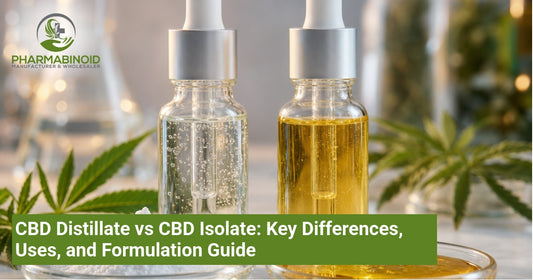
CBD-destillat vs. CBD-isolat: forskelle, anvend...
CBD-destillat vs. CBD-isolat er en vigtig sammenligning for brands, formuleringseksperter og købere, der arbejder med hampbaserede ingredienser. Begge materialer kan være rige på cannabidiol, men de adskiller sig i sammensætning,...
CBD-destillat vs. CBD-isolat: forskelle, anvend...
CBD-destillat vs. CBD-isolat er en vigtig sammenligning for brands, formuleringseksperter og købere, der arbejder med hampbaserede ingredienser. Begge materialer kan være rige på cannabidiol, men de adskiller sig i sammensætning,...